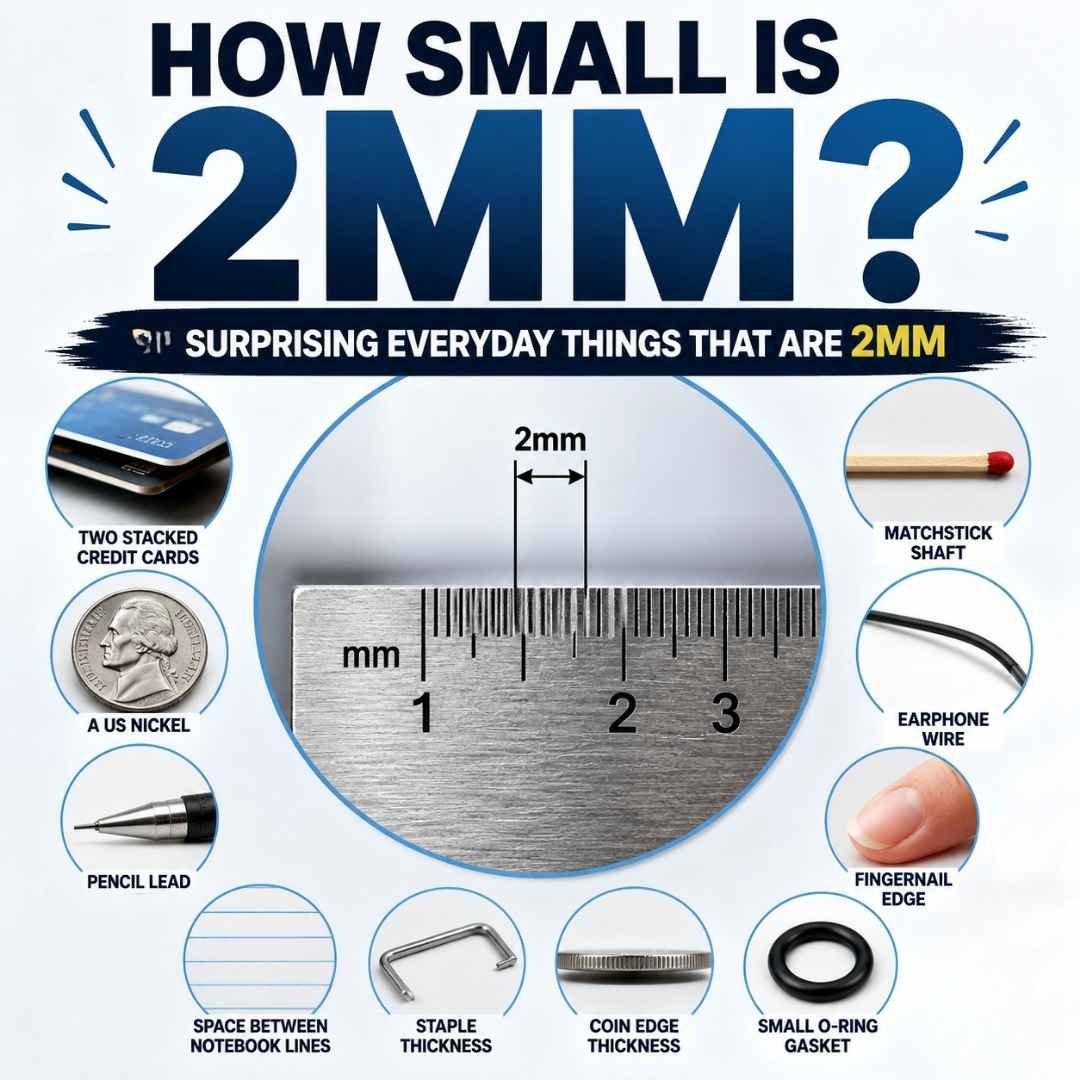
Most Americans think in inches, so how big is 2mm can feel confusing at first. In simple terms, 2mm equals 0.0787 inches one-tenth of an inch, or about 0.2 centimeters. It is a small measurement with tiny thickness, yet it appears more often than people realize.
I usually compare it with a thin coin edge, a small seed, or the tip of a pencil lead because these familiar everyday objects make the size much easier to understand than numbers alone. Even with the naked eye, you can notice this measurement once you know what to look for.
Knowing what does 2mm look like is useful in daily life, engineering, nature, precision crafts, jewelry, crafts, electronics, medical tools, and when working with screws or beads. It also helps when buying small items online, reading product dimensions, checking a ruler, comparing dimensions, or looking at a picture for scale.
Whether you are comparing it with 2 inches or 4 inches, understanding this level of precision makes it much easier to judge the true scale of everyday objects.
How Big Is 2mm? Exact Measurement, Size & Conversions
One inch is equal to 25.4 millimeters, making 2mm equal to about 0.0787 inches, or roughly eight hundredths of an inch. On a standard ruler, it appears as a very thin measurement that is easy to overlook at first glance.
Quick Overiew Conversion : 2mm in Different Units
| Unit | Equivalent |
| Inches | 0.0787 in |
| Centimeters | 0.2 cm |
| Meters | 0.002 m |
| Micrometers | 2000 µm |
| Feet | 0.00656 ft |
| Millimeters | 2 mm |
Since one millimeter is only (1/1000 of a meter), a measurement of 2mm is still remarkably small in any system.
📌 In practical terms:
| Conversion | Value |
| 1 centimeter (cm) | 10 millimeters (mm) |
| 2 millimeters (mm) | 1/5 of a centimeter (0.2 cm) |
What Does 2mm Look Like? A Simple Visual Size Guide
Humans don’t naturally visualize millimeters, so comparing them to familiar objects makes them much easier to understand.
Here are some easy ways to picture what 2mm looks like:
- The edge thickness of a U.S. nickel coin is approximately 1.95mm.
- A thick mechanical pencil lead can measure 2mm across.
- A mustard seed is usually around 1 to 2mm in size.
- The body width of a small black ant is roughly 1.5 to 2mm.
- A stack of about 20 sheets of paper is close to 2mm thick.
When I explain 2mm to someone, I always use familiar objects because research confirms that people consistently overestimate small sizes. Our brain lacks a natural reference scale for sub-centimeter items, so comparing them with everyday things makes this tiny measurement much easier to picture and understand instead of relying on numbers alone.
7 Real-World Objects That Are Around 2mm
The items below offer a practical way to imagine the actual size of 2mm.
Mechanical Pencil Lead
Mechanical pencil lead provides one of the most accurate everyday comparisons for a 2mm thickness.
- Ideal for drafting and technical sketching
- Standard size: 2mm diameter
- Built for strong, long-lasting performance
Why It’s Important
- Thicker than standard 0.5 mm and 0.7 mm pencil leads
- Built to reduce breakage during use
- Ideal for architecture, engineering, and technical sketching
Using a drafting pencil is one of the easiest ways to recognize what 2mm looks like.
U.S. Nickel Coin
- Made from a durable copper-nickel alloy
- Thickness: ~1.95mm
- A common coin you’ll often find in your pocket or wallet
Why it’s helpful:
- Easy everyday reference
- No measuring tools required
- Same size on every coin
The edge of a U.S. nickel is a great reference, measuring almost exactly 2mm thick.
Mustard Seed
Mustard seeds are one of the best real-world examples of an object measuring about 2mm in size.
- Approximately 1–2 mm in diameter
- Widely used in kitchens around the world
- Essential for cooking, spice mixes, and edible oil production
Interesting fact:
Mustard seeds may be tiny, but they’re loaded with:
- Rich in antioxidants
- Contains healthy fats
- Packed with natural flavor compounds
A perfect reminder that tiny objects can have a remarkable impact.
Small Black Ant
Many small ant species measure between 1.5 mm and 2 mm in length.
- Frequently found in homes and gardens
- A familiar natural size reference
- Easy to spot in everyday surroundings
Insight:
The length of a small ant’s body is roughly 2mm, making it a useful everyday size comparison.
A Ceramic Tile Spacer
If you want to picture 2mm, look at standard ceramic tile spacers used during home renovation. These small but critical tools ensure evenly spaced tiles with even grout gaps. A consistent gap directly affects the aesthetics and structural integrity of the final floor or wall.
From my own renovation experience, I have seen how a tiny 2 mm space can create a clean, professional finish that is easy to notice with the naked eye once the project is complete.
There are two main types that exist: X-shaped spacers for standard grid layouts and T-shaped spacers for brick-pattern installations. Choosing the wrong size or deciding to skip them can leave a visible difference across the finished floor, making the pattern look uneven even though the measurement is only 2mm.
A Matchstick
A standard matchstick is one of the easiest ways to picture 2mm because its shaft is about 2mm thick. I often use one as a quick measurement reference since it is universally known, yet many blogs miss this simple comparison.
The diameter is precisely engineered so the wood can burn steadily and safely with a single strike, making it a surprisingly accurate everyday size guide.
A matchbox holds dozens of sticks inside and measures 50.5mm by 37.5mm. They are packed tightly, but each matchstick still keeps the same consistent thickness.
That small gap between what people see and what they imagine makes this common item one of the best real-life examples for understanding just how small 2mm really is.
Earphone Wire
Many earphone wires are close to 2mm in thickness, especially lightweight wired earbuds, charging cables, and other electronic accessories made for portable devices.
A slim, flexible cable is easy to bend and store, yet it stays strong enough to protect the wires inside.
I often use this comparison when trying to estimate tiny measurements because most people use earphones regularly, making it a quick way to build an understanding of how big 2mm really is.
If you struggle to picture small sizes, think about the cord on a pair of earphones before looking at larger objects.
This makes shopping online for accessories much easier because you can better understand product dimensions without a ruler. Even when a standard size item measures around 20 inches in length, its cable can still be only 2mm thick, giving you a familiar reference from everyday life.
How to Estimate 2mm Without a Ruler
You do not always need a ruler to estimate 2mm. Many everyday objects and even parts of your body can help you judge this tiny measurement with surprising accuracy.
Using Your Fingers
The fingernail edge is often close to a few millimeters thick, making it a handy visual reference to picture the 2mm thickness. A thin slice across your nail is a simple size comparison that helps estimate this tiny measurement.
Using Coins or Cards
Two credit cards stacked together are close to 2mm thick. This simple visual reference makes it easy to estimate the size, thickness, and measurement quickly.
Where a 2mm Measurement Really Matters (Real-World Applications)
Many people think 2mm is simply a tiny measurement, but it is actually essential for precision work.
Engineering and Manufacturing
- Precision Machine Tolerances
- Electronic Component Gaps
- Small Fasteners and Screws
Jewelry Design
- Pavé diamond settings
- Tiny gemstone mounts
- Precision fine-detail work
Construction and Interior Design
- Precise tile spacing
- Even floor alignment
- Accurate finishing details
Art & Design
- Precise pencil control
- Fine sketch details
- Technical illustrations
Most Common Mistakes About 2mm
This small measurement is often misunderstood:
- Confusing 2mm with 2cm, making the measurement 10 times larger
- Thinking 2mm looks bigger than it really is
- Believing 2mm is too small to see, even though it is visible
- Assuming all small objects have roughly the same size or thickness
The Facts:
2mm is visible, but you need to look closely to notice it.
FAQs
How much is 2 mm visually?
A 2 mm measurement is about the thickness of a US nickel or the standard space between two lines in a college-ruled notebook. Looking at a notebook, its ruled lines, and the line spacing is an easy way to picture how small 2 mm really is.
What is an example of 2mm?
A 2mm measurement is roughly equivalent to 0.08 inches. A simple way to picture it is the thickness of two stacked standard credit cards, the width of an average US nickel, or the tip of a mechanical pencil with fine pencil lead.
Is 2mm very small?
Yes, 2mm is very small. It is equal and equivalent to 0.08 inches, just over an inch reference, and is easy to compare in size with the thickness of two stacked credit cards, the width of a standard pencil lead, or a US nickel.
Conclusion
A 2mm measurement may be tiny, but it is far from insignificant. Equal to 0.078 inches or 0.2 centimeters, it appears in many everyday things and everyday objects you may not notice at first. From a nickel in your pocket, a tile on the kitchen floor, or a black ant crossing the counter, to a gemstone in a pavé ring, sesame seeds, jewelry beads, pencil leads, screws, and watch parts, this size shows up almost everywhere. In my experience, using real-life examples is the easiest way to understand what 2mm really looks like.
Whether you are shopping online, working on crafts, repairing electronics, or estimating sizes without a ruler, it helps to compare the measurement with familiar objects. These simple comparisons make it much easier to picture and recognize this small size in daily life, turning an ordinary measurement into something both practical and surprising.