Trying to picture 10 kg without using a scale can feel surprisingly difficult. Ten kilograms sits in an awkward middle zone. It is not so light that you can ignore it, but it is not so heavy that lifting it feels dramatic either.
In plain terms, 10 kilograms is a solid two-armed load that you will definitely notice when you pick it up. I have found that the easiest way to understand this weight is through real life weight comparisons rather than staring at a number or relying only on exact conversions. Once you compare it with familiar everyday objects, the idea becomes much less fuzzy.
This kind of mental library is genuinely useful in daily life, whether you are packing a suitcase, choosing a load at the gym, estimating what a shelf can hold, or simply trying to eyeball how much different objects weigh.
Their size and length may vary, but seeing items that come right around the same weight makes weight comparisons much easier. the detailed and organized list below focuses on 13 interesting, everyday examples that make the weight easier to understand.
Quick Answer : 10 kg is equal to about 22.05 pounds, or roughly 1 stone 8 pounds. It also equals 10,000 grams, and 10 kg of water has a volume of approximately 10 litres
Overview Table :10 Kilograms in Pounds, Grams, Stone and More
| Unit | 10 kg Equals |
| Grams (g) | 10,000 g |
| Pounds (lb) | 22.05 lb |
| Litres of water (L) | About 10 L |
| Ounces (oz) | 352.74 oz |
| Metric tonne (t) | 0.01 t |
| Milligrams (mg) | 10,000,000 mg |
| Stone (st) | 1.57 st, or about 1 st 8 lb |
Why People Misjudge this Weight
When folks hear the number 10 kg, they often reach for kg-to-lbs conversions in a second because a figure feels safer to trust than their arms.
Unlike length, which has clear landmarks like a ruler, door frame, or the span of 10 inches on a desk, weight has almost none. That is why guessing is common, but if you tie 10kg to something real, familiar objects make conversions easier and the guessing stops because the comparison feels real.
13 Everyday Items That Weigh About 10 kg
You’ve probably picked up something this heavy before without even thinking about its weight.
A One-Year-Old Baby
One of the most relatable comparisons for understanding 10 kg is a 12-month-old child.
According to many growth charts, the median weight around age one often hovers near 9 kg to 10 kg, so a typical toddler weighs close to ten kilos. On a scale, that weight may not seem like much, but real life feels very different when you are carrying a squirming, wriggling load that refuses to sit still.
From what I have seen, parents, especially new parents, quickly understand how heavy this body weight can feel after a few minutes, which explains those familiar sore arms.
A 10 kilograms Bag of Flour or Rice
A 10 kg bag of flour or rice is one of the easiest ways to picture this weight in real life. During shopping, you will often see these staple foods sold in bulk at a supermarket, usually stacked on the bottom shelf with other grocery items and bulk foods.
From my own grocery runs, I find a large bag like this heavy enough to notice when you lift it, but still manageable to carry for a short distance.
That is why 10 kg feels like a practical sweet spot for food staples, offering useful savings without becoming too difficult to handle. If you have ever lifted one of these bags, you already have a familiar everyday example of what kg weight feels like in your hands.
A 10 kg Dumbbell
In gyms, a 10 kg dumbbell is an obvious pick because it is a standard rack weight found almost everywhere people train.
This dumbbell feels heavy enough to build real strength, but also light enough for most people to perform an overhead press or press overhead during regular training. That balance between heavy and light is one reason this weight stays popular on the rack.
A useful tip is to lift one just once and pay attention to your body feeling because your body quickly files the feeling away. Once you remember that feeling, guessing 10 kg becomes far easier, making guessing the weight of similar objects much easier when you already know how 10 kg feels.
Ten Liters of Water
A simple everyday example of 10 kg is ten liters of water. Since one liter of water weighs exactly 1 kilogram, a full camping jug or large water can holding ten liters weighs precisely 10 kg.
I find this especially useful when explaining water weight, because a liter of this common liquid gives you an easy reference you can picture and measure without needing a scale.
- A typical water can used for camping or emergency storage usually holds around 10 to 20 liters.
- Milk and juice are close to water in density, so a liter of either weighs roughly the same as a liter of water.
- That’s why liquid weight is such a useful reference point when you want to understand what a certain weight feels like.
A 24-Pack of Coke Cans
A 24-pack of soda cans is an easy way to picture 10 kg in everyday life. When you grab a full case of soda for a party or to stock the office fridge, you can immediately feel the weight.
The complete pack of cans usually weighs right around 10 kg, making it a useful comparison because most people have carried drinks from the shop to the office or loaded them into a fridge before.
- Each 12 oz can contains around 355 ml of soda and weighs roughly 384 grams when full.
- Multiply that by 24 cans, and the total comes to about 9.2 kg before counting the cardboard packaging.
- Add the weight of the cardboard box, and the full case lands very close to the 10 kg range.
A Bag of Potatoes
A standard bag of potatoes is one of the easiest ways to picture 10 kg in everyday life. Walk into a grocery store, and a large grocery bag filled with russet potatoes or Idaho potatoes can feel surprisingly heavy in your hands.
A typical potato sack, generic grocery potato sack, or 20-pound bag is close to this standard size, with the 20-pound bag serving as a useful imperial equivalent. From my experience carrying a full grocery bag home, this amount of potatoes gives you a very practical sense of what 10 kg actually feels like.
Two Bowling Balls
Two bowling balls are an easy way to picture 10 kilograms in real life.
A regulation bowling ball usually weighs within a weight range of about 4.5 kg to 7.3 kg, while the average weight is close to 5 kg. That means two standard bowling balls weighing around 5 kg each come together at almost exactly 10 kg.
If you have ever picked up a ball at a bowling alley, you already know how solid that weight feels, so holding two bowling balls gives you a practical sense of what 10 kilograms or 10 kg feels like in your hands, measured in kilograms.
- In competitive bowling, the heaviest ball allowed weighs 16 pounds, or about 7.26 kg.
Four Standard Bricks
Think about carrying four bricks at once. A standard red brick is a classic, rectangular block commonly used in construction, and because of its clay density, each brick weighs approximately 2.5 kg.
Put all four together, and their total weight reaches 10 kg exactly, making them an easy real-world way to understand what 10 kilograms feels like.
- Standard bricks are usually around 215 mm × 102.5 mm × 65 mm in size.
- Bricklayers can handle dozens of bricks every hour, so even a single brick’s weight quickly adds up across a busy job site.
A Full-Grown Beagle
A full-grown Beagle is a warm, living example of what 10 kg feels like in everyday life. These Dogs may look small, but they are dense little hounds, built for stamina on long scent trails, so their muscle quickly adds up.
A healthy adult Beagle usually weighs between 9 kg and 11 kg, putting its weight at roughly 10 kilograms. From experience, when you lift one onto a vet table, you immediately understand how much that weight feels because you have handled a very happy, wiggly 10 kg load.
A Countertop Microwave
A countertop microwave often weighs close to 10 to 13 kg, while some lighter models come very close to our target weight.
What surprises most people is that the heft comes from the heavy transformer and metal casing inside, rather than the plastic shell you can see.
From handling kitchen appliances, I’ve noticed that sliding this small little box onto a high shelf can feel much riskier than expected because its real weight is packed into a compact space. Once it is sitting on the shelf, it becomes clear how much weight hides inside such an ordinary appliance.
A 42-Inch Flat-Screen TV
Modern TVs are shockingly light when you compare their size with what they actually weigh. A 42-inch flat-screen TV, minus the stand, weighs roughly 8 kg to 11 kg, putting many models close to the 10 kg mark.
Today’s slim LED panels have stripped away much of the bulk found in old tube sets, so the display is now mostly screen with a thin frame instead of the heavy parts common in the tube era.
What makes this a useful everyday example is the size comparison. A screen that is nearly as wide as your arm span can weigh about the same as a rice sack.
I’ve always found that contrast a little odd because something that looks so large can feel surprisingly light when lifted, and that difference never stops being noticeable.
A 10 kg Gold Bar
A gold bar weighing 10 kg may have the same weight as a sack of potatoes, but the difference in value is huge.
At mid-2026 prices, with gold sitting around $4,000 per ounce, 10 kg gold can be worth well over a million dollars.
From my experience comparing everyday weights, this is a real showstopper because the same 10 kg that carries enough food for dinner can also represent a fortune. It is a strange thought that the weight stays exactly the same, while its value changes completely depending on what it is made of and current prices.
A Full Carry-On Suitcase
A packed carry-on is one of the easiest ways to understand what 10 kg feels like, especially for frequent flyers who know this number well. Many airlines set their cabin baggage limit around this weight, so it becomes important when you reach the gate.
A weekend bag with clothes, shoes, and a wash kit can reach ten kilos surprisingly easily because everything adds up fast. Go even a little over, and you could end up paying a fee or checking the bag instead. That extra weight often sneaks up much quicker than expected.
FAQs
How much is 10 kg in weight?
In terms of weight, 10 kg is equal to approximately 22.05 pounds, or about 22 pounds and 0.74 ounces. In the metric system, the same weight is equal to 10,000 grams.Thinking of 10 kg as roughly 22 pounds makes the number much easier to picture when comparing everyday objects.
Is 10kg a heavy weight?
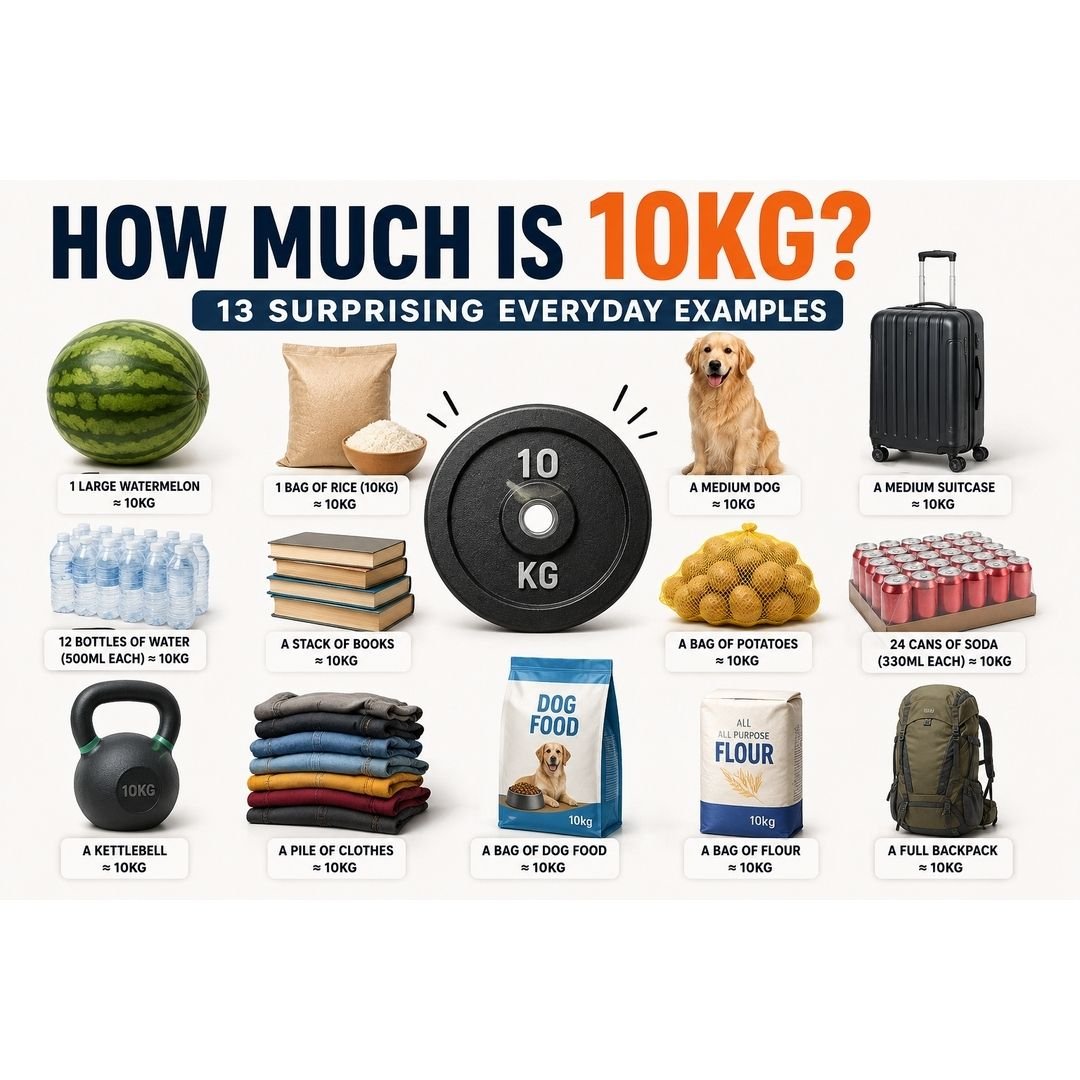
Ten kilograms, or 22 pounds, is a moderate, easily manageable weight for most healthy adults, and many can lift it with one hand. It feels similar to a large watermelon, medium-sized suitcase, 24-pack of soda cans, or a large bag of pet food.
What does 10 kg of clothes look like?
Ten kilograms of clothes can fill a full medium-to-large suitcase or a large bulging backpack. It may also look like a sizable pile of roughly 30 to 50 mixed garments, around 30–50 adult clothing items, or up to 50 lightweight t-shirts.
Conclusion
Once you start paying attention, 10 kilograms seems to be everywhere. A loaded carry-on bag, a heavy grocery run, or groceries in bulk can quickly reach this weight. You might notice the same feeling when packing, hauling groceries, or moving a sack of rice from the kitchen pantry to the kitchen counter.
Even a French Bulldog sitting on your lap or resting on the couch can give you a surprisingly accurate feel for 10 kg. What first seems like an abstract number becomes much more real when you connect it with something real from everyday life.
For me, the easiest comparison comes from familiar places like the kitchen, gym, and living room. Think of a large watermelon, a 10 kg weight, a dumbbell near the gym rack, a gym bag filled with weights, or a heavy bulk rice sack you need to pick up. A dog stretched across your living room couch can work just as well.
Whether you are working with, carrying, or lifting these objects, these things that weigh 10 kg make what 10 kilograms truly means much easier to understand. Even looking through a list of 8 examples can give you an instant sense of the weight, but your favorite comparison will usually be the one you have handled yourself, whether that is groceries, a carry-on, or a Bulldog.