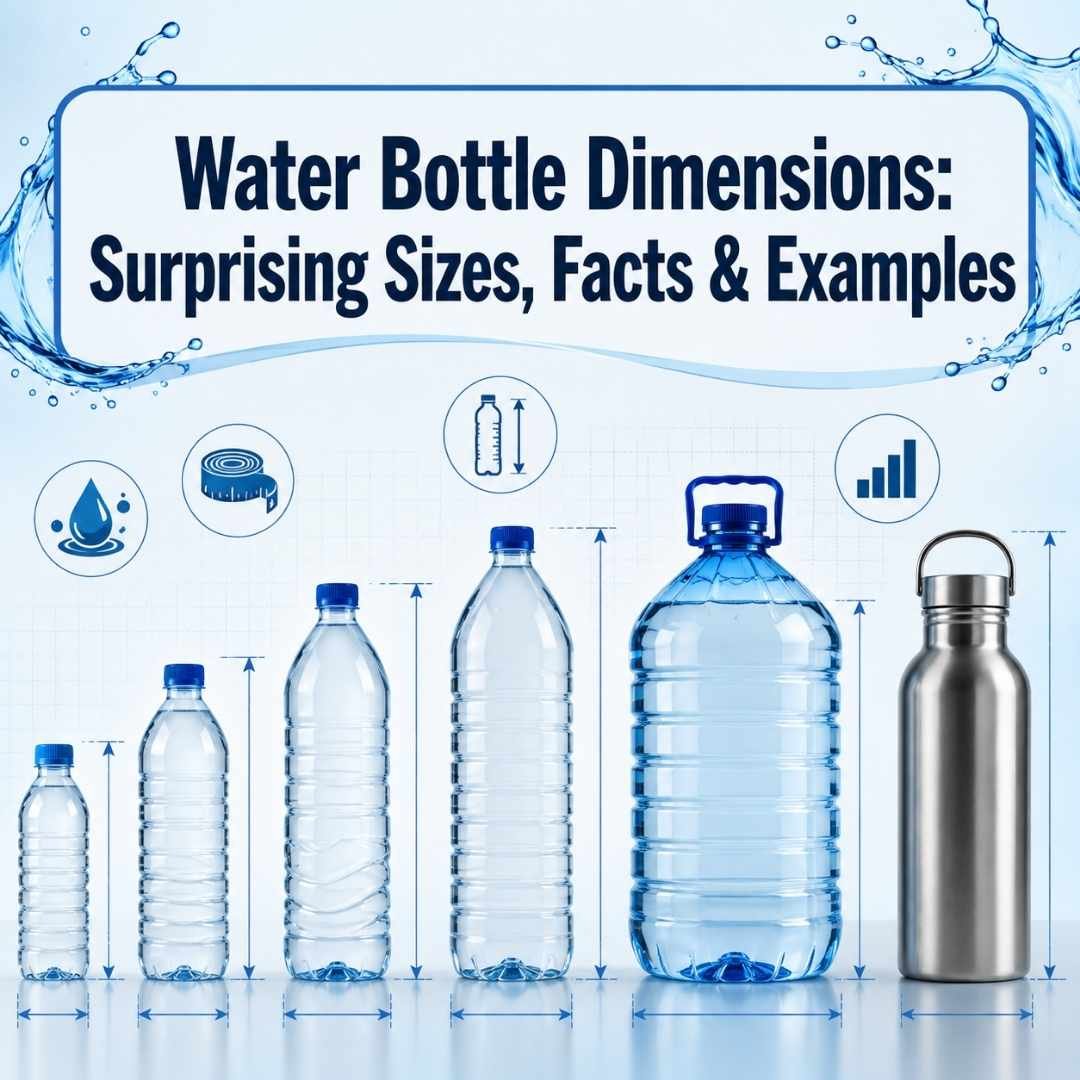
A reusable bottle should match your daily routine, whether you are travelling to work, going to the gym, preparing for travel, or buying a new reusable bottle. Knowing the water bottle dimensions helps when checking bottle fit in a car’s cup holder, planning storage space, or choosing the correct water bottle size for better portability, convenience, and overall usability.
A standard water bottle is often around 8 inches or 20.3 cm long and tall, but its exact measurement depends on the design, container, bottle shapes, bottle designs, and numerous material types used by manufacturers. The standard size may work for a typical person, while a small 8-ounce bottle may suit short trips and a large 2-liter hydration bottle may be better for extended activities. These significant differences in heights, capacities, weights, and dimensions by size can affect whether the bottle fit is comfortable and practical for its intended use.
From my experience comparing many shapes and many capacities, understanding water bottle dimensions and comparing sizes before purchase makes it easier to find the optimal bottle for your lifestyle, available storage space, and everyday use, while supporting a recyclable alternative to the 167 plastic water bottles often used as an everyday item.
This article will investigate common water bottle lengths, water bottle capacities, water bottle heights, water bottle weights, bottle measurement, and understanding specifications through perceptive facts, practical examples, real-world situations, visual aids, facts, examples, and useful specifications.
Water Bottle Dimensions
A 750 milliliter bottle is a popular choice because it holds about three cups of water, but the right bottle size depends on your daily needs. When picking a proper water bottle, check its dimensions as well as its volume, especially if it must fit inside a bag, holder, or storage space
Common obtainable capacities usually begin at 500 milliliters and reach up to 1,500 milliliters, creating a practical capacity range for different activities.
From my experience, a smaller conventional bottle is easier to carry, while larger capacities reduce the need for frequent refilling, so choosing the right water bottle means balancing size, portability, and the number of milliliters you need.
Below are the standard measurements commonly found across different water bottle sizes:
| Bottle Size | Ounces | Milliliters | Cups | Liters | Common Uses |
| Mini | 8 oz | 237 ml | 1 cup | 0.24 L | Ideal for children’s lunch boxes and smaller drink portions |
| Small | 12 oz | 355 ml | 1.5 cups | 0.35 L | Suitable for quick hydration, short outings, or snack packs |
| Standard | 16.9 oz | 500 ml | About 2.1 cups | 0.5 L | A common choice for everyday use and vending machines |
| Medium | 20 oz | 591 ml | 2.5 cups | 0.59 L | Useful for workouts, office hours, and daily commutes |
| Large | 32 oz | 946 ml | 4 cups | 0.95 L | A practical option for hiking and longer outdoor activities |
| Extra Large | 33.8 oz | 1,000 ml | About 4.2 cups | 1 L | Designed for staying hydrated throughout the day |
| Jumbo | 50.7 oz | 1,500 ml | About 6.3 cups | 1.5 L | Best for sharing, long work sessions, or keeping on a desk |
| Cooler Jug | 640 oz | 18,927 ml | 80 cups | 18.9 L | Commonly used in office water coolers and home dispensers |
How Many Inches Is A Water Bottle?
A water bottle’s height depends on its capacity and design, but standard bottles usually range from 8 inches to 10 inches tall.
In my experience comparing different bottle sizes, an 8-ounce bottle is about 5.5 inches, while a 12-ounce bottle is approximately 7 inches tall.
Most ordinary bottles and plastic bottles commonly measure close to the standard size, but bigger varieties and larger bottles can reach 11 inches or even 12 inches. These measurements make it easier to estimate the right bottle height for cup holders, bags, shelves, and storage spaces.
What Is the Average Water Bottle Height?
Bottle height can fluctuate significantly because water bottles are designed to lodge diverse needs. A standard bottle typically measures around 8 inches, or 20 cm, while compact 6-inch bottles and 8-ounce containers offer a more concise option for packing and travel.
At the other end of the size range, a large bottle, large containers, and 1-gallon jugs may reach or surpass 12 inches, or 30 cm, depending on how much of a gallon they hold.
Comparing bottle dimensions, fathoming these height measurements, size variations, and each measurement comparison is beneficial for making certain the bottle has an appropriate fit and proper dimensional fit inside bags, storage spaces, and vehicle cup holders, especially when choosing between smaller containers and taller jugs.
How Many Ounces Is A Standard Water Bottle?
A customary water bottle typically holds 16.9 ounces, equal to 500 milliliters. This volume and magnitude are broadly acknowledged for their convenience and aptness for daily hydration.
In my experience, this bottle capacity is perfect for use at work, in the gym, or during open-air activities, as it meets most everyday hydration needs without feeling too heavy.
People necessitating considerable hydration may prefer larger bottles possessing 32 ounces or more. These sizes are widely available and can be a flawless option for intense workouts or extended days when regular refilling may not be practical.
Quick Conversions: Ounces, Milliliters, Cups, and Liters
When comparing bottle sizes or keeping track of your daily water intake, you’ll often need these common unit conversions:
- 1 fluid ounce = 29.57 milliliters (mL)
- 1 cup = 8 fluid ounces (oz)
- 1 liter = 33.8 fluid ounces (oz)
- 1 gallon = 128 fluid ounces (oz)
| Conversion | How to Calculate | Example |
| Ounces to milliliters | Multiply the number of ounces by 29.57 | 16.9 oz × 29.57 = approximately 500 ml |
| Milliliters to ounces | Divide the number of milliliters by 29.57 | 500 ml ÷ 29.57 = approximately 16.9 oz |
| Ounces to cups | Divide the number of ounces by 8 | 16.9 oz ÷ 8 = approximately 2.1 cups |
| Liters to ounces | Multiply the number of liters by 33.8 | 1 liter × 33.8 = 33.8 oz |
How Bottle Capacity Influences Its Height
Many people think that doubling a bottle’s capacity will also double its length, but that is rarely the case.
Why Larger Bottles Don’t Always Mean Extra Height
Manufacturers increase storage capacity by:
- Increased height
- Wider diameter
- Custom-shaped designs
For example:
| Bottle Capacity | Approximate Height |
| 500 ml | 8 inches |
| 1 liter | 11 inches |
Even though the capacity is twice as large, the bottle is only 3 inches taller.
Comparison between Tall orNarrow Bottles and Short or Wide Bottles
Each design offers its own unique benefits.
Tall and Narrow Bottles
Advantage:
- Fits easily in most cup holders
- Comfortable to carry on the go
- Clean and modern design
Disadvantage:
- Higher center of gravity
- Greater chance of tipping over
Short and Wide Bottles
Advantage:
- Greater steadiness
- Simpler to clean
- Improved insulation potential
Disadvantage:
- Poor fit in standard cup holders
- Takes up more storage space
The Engineering That Shapes Bottle Design
Bottle designers consider several important factors:
- User comfort and ease of use
- Cost of materials
- Overall stability
- Storage capacity
- Manufacturing efficiency
Even a slight increase in diameter can add much more volume without making the bottle noticeably longer.
How to Measure a Water Bottle’s Length
You can easily take accurate measurements at home.
Essential Tools You’ll Need
You can also use:
- Ruler
- Tape Measure
- Calipers
- Measuring Stick
A Simple Step-by-Step Guide to Measuring
- Place the bottle upright on a level surface.
- Hold a ruler vertically beside the bottle.
- Measure from the bottom of the bottle to the top edge.
- Write down the measurement in inches or centimeters.
Measuring Bottles with Irregular Shapes
For bottles with handles or distinctive designs:
- Measure the item from its base to the highest point.
- Measure the widest part of its diameter separately.
- Write down both measurements.
This gives you the most accurate size details.
How to Choose the Right Water Bottle Length for Your Needs
The ideal bottle size depends on what you plan to use it for.
For Car Cup Holders
Most vehicle cup holders can comfortably fit bottles in the following sizes:
- Measures up to 3 inches in diameter
- Stands up to 10 inches tall
A 500 ml or 20-ounce bottle is usually the best choice.
For Backpacks and School Bags
Recommended Bottle Length:
- Between 7 and 10 inches
These sizes fit comfortably in most side pockets without sticking out too much.
For Sports and Outdoor Activities
People who spend time outdoors usually benefit from:
- 32-ounce water bottles
- 1-liter water bottles
- 2-liter hydration bottles
Larger bottles need to be refilled less often.
Water Bottle Lengths Across the World
Bottle sizes can differ depending on the region.
Popular Bottle Sizes Around the World
Common bottle sizes include:
| Region | Common Bottle Sizes |
| North America | 500 ml, 591 ml, 1 liter |
| Europe | 500 ml, 750 ml, 1.5 liters |
| Asia | 350 ml, 500 ml, 1 liter |
| Australia | 600 ml, 750 ml, 1 liter |
Although bottle sizes vary by region, most are typically between 7 and 12 inches tall.
Metric vs Imperial Measurements
Consumers commonly come across both systems.
Quick Answer:
| Measurement | Equivalent in Centimeters |
| 1 inch | 2.54 cm |
| 8 inches | 20.3 cm |
| 10 inches | 25.4 cm |
| 12 inches | 30.5 cm |
Surprising Facts About Different Water Bottle Sizes
Why Most Bottles Measure Around 8 Inches in Height
The popularity of the 500ml bottle is no coincidence.
Manufacturers often prefer this size because it:
- Fits easily into most standard cup holders
- Works well with most vending machines
- Offers convenient hydration on the go
- Helps reduce storage and transportation costs
How Bottle Size and Shape Affect Your Hydration Habits
Studies show that people often drink more water when larger bottles are readily available, improving daily hydration behavior.
A larger bottle:
- Needs refilling less often
- Acts as a helpful visual reminder
- Makes it easier to track daily water intake
However, oversized bottles can be less convenient to carry and may limit portability.
Important Note
““The best water bottle isn’t always the largest; it’s the one you’ll carry with you and use regularly.”
FAQs
What are the dimensions of a 500 ml water bottle?
A standard 500 ml water bottle typically holds 16.9 fluid ounces, or roughly 2 cups. From my experience comparing common bottle dimensions, this size usually measures 7.75 to 8 inches tall and has a 2.5-inch diameter, although its exact shape may vary slightly by brand.
What are the dimensions of a 1 liter water bottle?
A 1-liter water bottle has a capacity and volume of 33.8 fluid ounces, or 4.2 cups. Its physical dimensions and bottle dimensions are usually 9 inches to 11 inches in height, with a diameter of 3 inches to 3.5 inches. This tall, standing approximate size may vary by brand, while measurements for one liter may also use ounces, fluid ounces, or cups.
What is the standard size of a water bottle?
A single-use plastic water bottle usually holds 16.9 fluid ounces or 500 milliliters, making it the standard size for store-bought packs and a default bottle of water. Reusable daily-use bottles commonly have a size range of 18 ounces to 24 ounces, offering a good carrying balance, easy carrying, and enough hydration capacity.
These popular sizes are available as metal containers, hard plastic containers, or other plastic containers, making reusable bottles practical for good hydration, while disposable bottles remain convenient for quick use.
Conclusion
Selecting the right water bottle starts with matching its dimensions and capacity to your specific needs. Most standard water bottles are about 8 inches long, making them suitable for everyday use, commuting, and limited storage space. Smaller bottles measuring 5.5 to 7 inches offer a useful compact option for a short hike, while larger hydration bottles can reach or exceed 12 inches. Common capacities such as 500ml, 750ml, and 1,000ml provide a diverse range of sizes for different hydration needs.
Before choosing a water bottle, consider its length, diameter, weight, and intended use. A compact bottle may provide a better fit inside a gym bag, while a higher-capacity container is more practical for intense gym sessions, extended workouts, outdoor adventures, and longer excursions. From my experience, the bottle’s design, bottle’s shape, and material matter just as much as size because they affect comfort, convenience, overall performance, and your daily hydration experience. The best choice is one that fits your lifestyle and is easy to carry and use.