
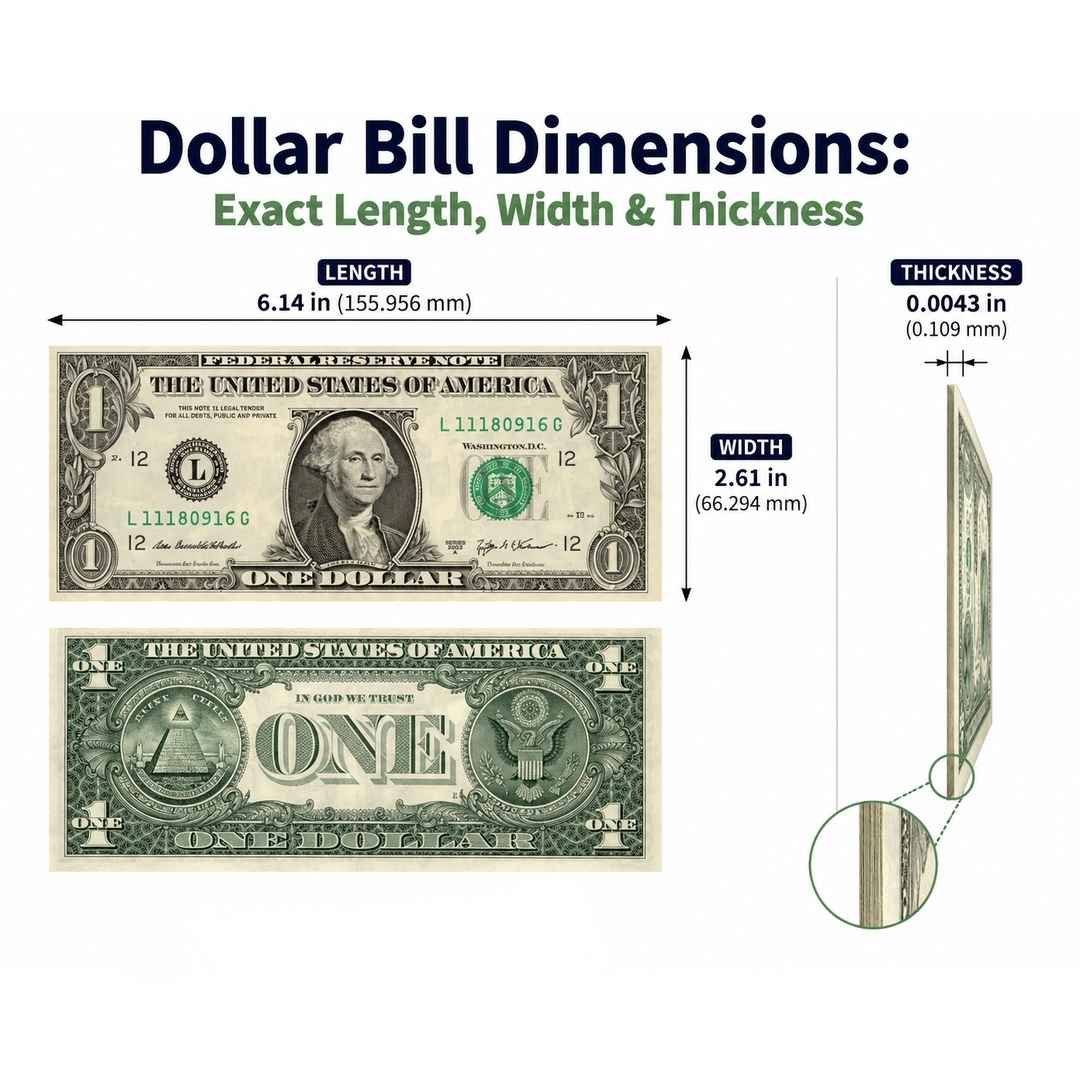
A US dollar bill may seem simple, but every denomination of U.S. currency, from the $1 bill to the $100 bill, shares the same dimensions and identical measurements.
The physical size of US paper currency has remained standard and constant for nearly a century, making each Dollar bill easy to stack, fold, carry in a pocket, and handle during daily use.
This guide will break down everything you need to learn about dollar bill dimensions, including the exact measurements, exact size, and specific size of American money currently in circulation.
From my experience, knowing these details is useful for anyone, including collectors, educators, and business owners, who is curious about cash, how it is held, historical changes, World currencies, comparisons, fascinating trivia, and surprising facts.
Quick Answer : A US dollar bill measures 6.14 inches long, 2.61 inches wide, and 0.0043 inches in thickness. These exact measurements became the standard dimension in 1929, when the Treasury Department modernized American currency, and the dollar bill dimensions have remained unchanged.
Historical Evolution of Dollar Bill Dimensions
Early bills in US currency were bigger and varied in size, making them less practical to handle. Over time, their design changed, and now all denominations have uniform dollar bill dimensions, which makes them easier to print, store, and use.
This change reduced costs and made handling easier.
Historical Timeline of Dollar Bill Size Changes
Before 1929, US dollar bills were larger, measuring about 7.42 inches by 3.125 inches. These bulky notes were often called horse blankets because of their oversized shape.
In 1929, as the Great Depression era began, the U.S. Treasury introduced a major size cut to save paper and cut costs by nearly 30 percent. This change created the current dollar bill dimensions of 6.14 inches long and 2.61 inches wide.
From my experience studying historical records, this was one of the most important major size shifts in American currency; although the designs and security updates have continued to evolve, the bills have kept their fixed sizes.
Benefits of Modern Standardization
Modern standardized dimensions allow currency counters, ATMs, and vending machines to operate efficiently.
Because every denomination follows identical size specifications, the banking industry can improve machine processing and simplify daily currency handling, without adjusting equipment for different denomination sizes.
Consistent dollar bill measurements also make mass production faster and cheaper. From my experience, this uniform design is practical because wallets and cash registers do not need special compartments for different bill sizes.
What Are the Exact Measurements of a Dollar Bill?
Standard Size in Inches and Centimeters
A dollar bill has an official dollar bill length of 6.14 inches, equal to 156 millimeters, while its width is 2.61 inches, or 66.3 millimeters in the metric system.
From my experience checking currency specifications, these measurements remain consistent because the Bureau of Engraving and Printing follows strict dimensional standards for every bill produced.
Quick Measurement Reference Table
| Measurement | Imperial Unit | Metric Unit |
| Length | 6.14 inches | 156 mm |
| Width | 2.61 inches | 66.3 mm |
| Thickness | 0.0043 inches | 0.109 mm |
| Weight | 0.035 ounces | 1 gram |
Are All U.S. Bills the Same Size in CM?
Yes, all U.S. dollar bills are the same size.
Consistent Across All Denominations
- $1
- $5
- $10
- $20
- $50
- $100
Each one is 15.6 cm long and 6.6 cm wide.
What Changes, Then?
Although the size remains the same, there are several differences:
- Portraits, such as George Washington and Benjamin Franklin
- Colors and visual design elements
- Security features, including security threads and watermarks
Dollar Bill Thickness in Centimeters: An Often-Overlooked Detail
Most guides highlight length and width, but thickness matters just as much.
| Measurement | Thickness |
| Single bill thickness | 0.011 cm |
| Equivalent thickness | 0.109 mm |
It is even thinner than a standard sheet of paper.
What Material Is a Dollar Bill Made From?
U.S currency is not made from ordinary paper. Instead, it is made from:
- 75% cotton
- 25% linen
This combination offers:
- Exceptional durability
- Strong resistance to tearing
- Designed to withstand thousands of folds
Calculating Stack Height in Centimeters
Knowing the stack height makes these measurements more practical.
Examples of Common Stacks
| Number of Bills | Approximate Stack Thickness |
| 10 bills | 0.11 cm |
| 100 bills | 1.1 cm |
| 1,000 bills | 11 cm |
A stack of 1,000 dollar bills is approximately 4.3 inches (10.9 cm) tall.
Practical Visual Representation
| Number of Bills | Approximate Stack Height |
| 1,000 bills | About the height of a coffee mug |
| 10,000 bills | Around 110 cm, or just over 1 meter |
| 1,000,000 bills ($1 million) | Around 109 meters tall |
Comparing Dollar Bill Dimensions with Everyday Objects
Credit Card vs Dollar Bill Size
A standard credit card measures 3.37 inches by 2.125 inches, making it significantly smaller than a dollar bill. The bill’s 6.14-inch length is nearly twice the credit card length. When both items are compared in inches, the difference in bill length is easy to notice.
Both credit cards and bills provide a convenient wallet fit and can be carried in standard wallets, although the longer bill may require folding. Credit cards maintain a rigid structure, while flexible bills have a flexible structure that allows them to bend and fold easily.
Smartphone vs Playing Card
Standard playing cards measure about 3.5 x 2.5 inches, so they are shorter but slightly wider than dollar bills. Placing both objects together makes the comparison clear and helps you understand the bill’s size without using measuring tools.
A dollar bill length of 6.14-inch is close to a 6.1 inches smartphone screen and roughly matches the visible length of a phone such as the iPhone 13 Pro Max. In portrait mode, the bill looks about half as wide as the screen, making it easier to visualize its dimensions in inches.
Why the Size of a US Dollar Bill Matters
ATM and Vending Machine Compatibility
Vending machines can accept all bills through identical slot sizes because U.S. currency uses standardized bill dimensions. In the same way, ATMs can dispense any denomination without needing special mechanical adjustments for different note sizes.
From my experience studying currency measurements, this uniformity makes modern cash-handling equipment simpler and more reliable. Financial institutions worldwide use these consistent measurements to design machines, which reduces maintenance needs and manufacturing costs.
Wallet and Storage Design
Storage systems use the fixed dimensions of a dollar bill to optimize space. A bank, cash registers, and vaults are designed based on the standard size, so every identical bill occupies a predictable area and improves efficiency.
The bill’s size also dictates each wallet compartment globally. Manufacturers measure bills precisely to fit different wallet sizes and allow neat folds without excessive wear.
Security Features and Anti-Counterfeiting
The Treasury regularly updates anti-counterfeiting features without changing the standardized bill size.
Its 6.14 x 2.61 inch format provides optimal space for important security elements like watermarks, protective threads, microprinting, and UV inks. These details fit perfectly within the fixed dimensions of U.S. currency.
From my experience reviewing currency specifications, this design consistency helps the public recognize a genuine dollar bill instantly while allowing new security technology to be added without altering its familiar shape.
Interesting Facts About Dollar Bill Size
- The size of a U.S. dollar bill has remained unchanged since 1929.
- Each bill weighs approximately 1 gram.
- It can endure thousands of folds before tearing.
- A dollar bill is often used as a handy reference for measuring objects.
Helpful Tips for Remembering Dollar Bill Dimensions in CM
Here are some easy ways to remember:
The “15 by 6 Rule”
Consider:
- Length: Approximately 15 cm
- Width: Approximately 6 cm
Quick Visual Reference
Imagine:
- A slim rectangular shape, slightly wider than your phone.
Simple Everyday Memory Trick
Use a dollar bill as a handy reference for quickly measuring small objects.
FAQs
What’s the actual size of a $100 bill?
The 6.14 x 2.61 inches size applies to every modern $100 note. Its back was changed to feature an Independence Hall vignette, while a black seal to the left of the portrait bears the name of the distributing Federal Reserve Bank.
Is a dollar bill 12 inches?
No. Modern Federal Reserve notes have note dimensions of 6.14 x 2.61 inches. This measuring size is 30 percent smaller than the former 7.375 x 3.125 inches, a size reduction designed to cut manufacturing costs and produce notes at lower costs.
How wide is a $20 bill?
A modern United States 20 dollar bill is 2.61 inches, or 66.3 millimeters, wide. It is also 6.14 inches, or 156 millimeters, long, matching the standard dimensions of other current US paper bills.
Conclusion
Dollar bill dimensions of 6.14 x 2.61 inch, or 15.6 × 6.6 cm, reflect nearly a century of American financial standardization. These precise measurements support efficient banking systems, improve machine compatibility worldwide, and make cash easier to handle during everyday transactions.
The uniform sizing across all denominations focuses on practical efficiency rather than the accessibility features used in some other currencies. This consistency remains a defining characteristic of American paper money.
Looking beyond the numbers, each bill follows a carefully designed standard that connects American currency, wallet design, and global financial systems. While many countries use different banknote sizes, the United States keeps the same dimensions to support modern banking.
From my experience studying currency measurements, this standard plays a crucial role in efficiency, durability, and usability. It also gives a new perspective on a simple piece of currency, showing that it is both a practical tool, a design marvel, and an important part of financial history.